
This study addresses a major debate regarding the causality of the C9ORF72 gene mutation in neurodegenerative diseases: does this mutation cause ALS and FTD via toxic RNA aggregates or toxic DPR proteins?
Traditionally considered distinct diseases, ALS and FTD share certain characteristics. In 2011, two research teams independently discovered that an abnormal repeat of the GGGGCC sequence in the C9orf72 gene is the most common genetic cause of ALS/FTD. In most people, this sequence is repeated between two and 20 times, but in some individuals, it can be repeated thousands of times. It is currently the most frequently observed mutation associated with ALS, far more common than SOD1, FUS, or TDP-43.
Ribonucleic acid (RNA) consists of a transient copy of a portion of DNA corresponding to one or more genes of a biological organism. mRNA is used by cells as an intermediary for protein synthesis. mRNA is a copy of DNA, comprising the coding region flanked by non-coding regions. It is synthesized as a precursor in the cell nucleus during a process called transcription. It then undergoes several maturation steps; some non-coding regions called introns may be excised during a process called splicing. The matured mRNA is exported to the cytoplasm where it is translated into protein by a ribosome. The information carried by mRNA consists of a series of codons, consecutive triplets of nucleotides, each of which codes for one amino acid of the corresponding protein. The sequence of these codons constitutes the gene itself, or cistron.
Normally, when a section of messenger RNA is converted into a protein, this section is delimited by a start codon and a stop codon. However, there is sometimes an abnormal conversion from an unconventional starting point, by translation of extended hexanucleotide repeats present in an intron of the C9orf72 gene, which produces short proteins called dipeptide repeat proteins (DPRs) that could be toxic.
However, the mechanism by which the expansion of the hexanucleotide repeat of the C9orf72 gene induces neurodegeneration remains poorly understood. An important question, therefore, is to determine whether it is the abnormal repeat of the GGGGCC sequence in the C9orf72 gene or the abnormal translation of the RNA of this gene that is toxic to neurons.
This study concludes that dipeptide repeat proteins (DPRs) are the main drivers of the disease, and not the RNA aggregates (foci).
Scientists have long struggled to separate these two factors, because DPRs are translated directly from the mutated RNA. To solve this problem, researchers used an ingenious gene-editing technique:
Target: They identified a specific start codon (CUG) that triggers the translation of the toxic proteins.
Modification: They replaced this CUG codon with CCG.
Result: The cell still produced the mutated RNA (and the resulting RNA foci), but it could no longer "read" the instructions necessary for the synthesis of the toxic DPR proteins.
 By testing this approach on mouse models of both diseases and on human patient stem cells (iPSCs), the team observed several crucial improvements:
Behavior: Complete recovery of motor and cognitive deficits in mice.
Brain health: Reduction of neuroinflammation and significant increase in neuronal survival.
Biomarkers: Decreased levels of NfL (a protein released into the bloodstream upon neuronal death).
Cellular pathology: Elimination of TDP-43 aggregates, a "waste" protein characteristic of ALS/FTD.
This discovery opens a new chapter for potential therapies. Instead of tackling the complex challenge of eliminating all the mutated C9ORF72 RNA (which may have other vital functions), we can now focus on strategies to specifically target and block the production of these toxic DPR proteins.
Here’s how this could lead to future treatments:
CRISPR gene editing: The very technique used in this study—CRISPR base editing—could be harnessed for therapeutic purposes. Delivering a “molecular editor” to brain cells to change the critical CUG codon to CCG could be a one-time treatment that permanently prevents DPR synthesis. This would involve significant challenges in terms of delivery to the brain and ensuring specificity, but the potential is immense.
Antisense oligonucleotides (ASOs): These custom-designed molecules are already used in other neurological disorders. ASOs could be developed to bind specifically to RNA at or near the CUG start codon, physically blocking the cellular machinery of its translation into DPR.
Small molecule drugs: The pharmaceutical industry could search for small molecules capable of interfering with the RAN translation process itself, or of specifically targeting proteins involved in the initiation of DPR synthesis. This approach could be a more traditional, drug-analytical alternative.
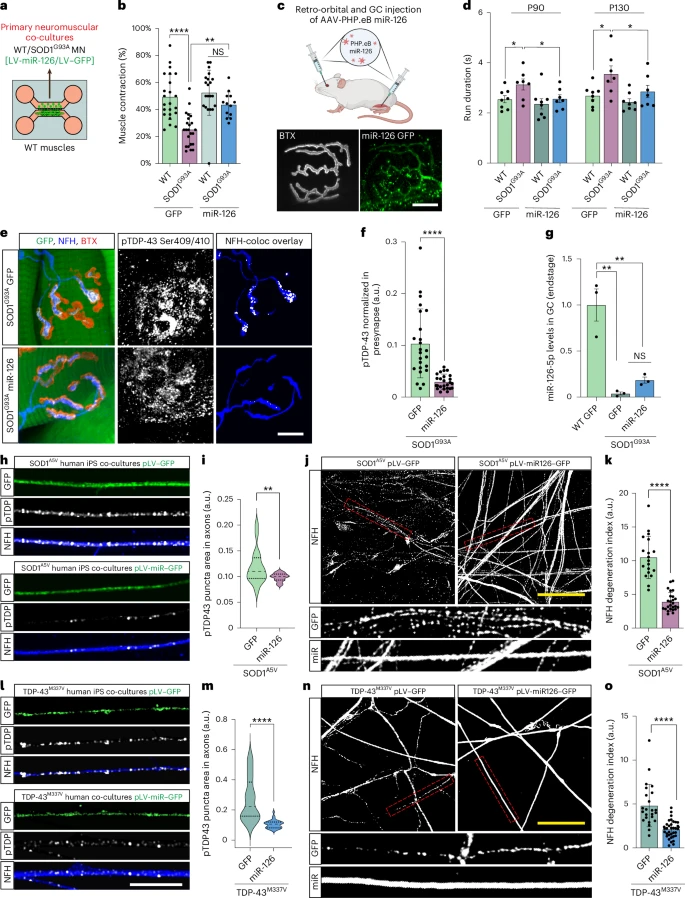 When pathologists examine the spinal motor neurons of patients with SOD1-related ALS, the nuclei generally appear normal: the TDP-43 protein is always present, and abnormal aggregates are rarely observed. This is why SOD1-related ALS has been considered "TDP-43 negative."
 Analyses statistiques contestables
