
When Japan's pharmaceutical regulators approved a new treatment for Amyotrophic Lateral Sclerosis (ALS) in September 2024, it marked a significant moment in the decades-long search for therapies that can slow this devastating disease. The drug, Rozebalamin®—a high-dose formulation of mecobalamin (vitamin B12)—represents an entirely different approach to treating ALS, and the clinical trial data suggests it may offer patients something precious: more time with meaningful function.
For decades, treatment options have been limited. Riluzole, approved in the 1990s, extends life by approximately two to three months but has minimal impact on day-to-day function. More recently, edaravone showed modest benefits but requires an intensive intravenous infusion schedule. The field has desperately needed options that make a tangible difference in how patients live.
Mecobalamin is nothing new—it's an active form of vitamin B12, long used at low doses to treat peripheral neuropathy. But in the 1990s, Japanese researchers began exploring whether dramatically higher doses—50 to 100 times the standard amount—might have neuroprotective effects in ALS.
The hypothesis centers on homocysteine, an amino acid that, at high levels, appears toxic to neurons. Mecobalamin acts as a coenzyme for methionine synthase, the enzyme that converts homocysteine to methionine. By lowering homocysteine levels, high-dose mecobalamin may protect motor neurons from damage. Additionally, through its role in methylation—a process essential for nucleic acid and protein metabolism—it may help repair nerve tissue.
Preclinical studies offered early promise. In Wobbler mice, an animal model of ALS, high-dose mecobalamin significantly slowed the decline in grip strength and increased motor neuron survival.
The road to approval wasn't straightforward. An initial Phase II/III trial (known as Trial 761) failed to meet its primary endpoint when looking at the general ALS population. However, researchers noticed something intriguing: patients who had been diagnosed early appeared to benefit. That observation led to the withdrawal of an initial application in 2015 and a redesigned study focusing specifically on early-stage patients.
The JETALS study was an investigator-initiated Phase III trial that enrolled patients within one year of their first ALS symptoms. Crucially, researchers also stratified participants by how rapidly their disease was progressing, focusing on "moderate progressors"—those losing one to two points on the standard ALS functional rating scale (ALSFRS-R) during a 12-week observation period.
The results, published in early 2026, were striking:
Over 16 weeks of treatment:
Patients receiving high-dose mecobalamin (50 mg) saw their ALSFRS-R scores decline by an average of 2.7 points
The placebo group declined by 4.6 points. This represents a 43% slowing of functional decline—a difference of approximately two points on the 48-point scale
For the 90% of participants also taking riluzole, the benefit was even more pronounced: a 45% slowing of decline.
In ALS, where every point on the ALSFRS-R represents a concrete ability—using a pen, climbing stairs, swallowing safely—preserving two points over just four months translates directly into maintained quality of life.
Perhaps even more compelling were the long-term findings. Post-hoc analyses of patients who started treatment early suggested an extension in "event-free survival" (time until death or the need for permanent ventilation) of approximately 500 to 600 days. In a disease where existing drugs add months, gaining nearly two years is extraordinary.
Equally remarkable was the safety profile. The drug was well-tolerated, with side effects limited to minor issues like injection site pain, constipation, or rash—comparable to placebo. This stands in sharp contrast to many neurologic drugs that require balancing efficacy against toxicity. As one neurologist noted, achieving a 43% slowing of a fatal disease with the safety profile of a vitamin is something of a "holy grail."
The "early window" appears critical. The drug seems most effective when started within 12 months of symptom onset, before significant motor neuron loss has occurred. For patients further along in the disease course, the damaged nerves may be beyond rescue.
The JETALS trial enrolled a specific population, which matters for interpreting the results:
Disease duration: Less than one year since first symptom
Progression rate: Moderate (1-2 point decline on ALSFRS-R over 12 weeks)
Physical status: Ambulatory, able to live with minimal assistance
Lung function: Forced Vital Capacity greater than 60%
Both sporadic and familial ALS patients were included, provided they met established diagnostic criteria. The focus on "moderate progressors" reflects trial design considerations—patients who decline too slowly make it difficult to measure drug effects in a 16-week study, while those declining too rapidly may have disease too aggressive for any current therapy to slow measurably.
Rozebalamin® is not a cure. It slows decline but does not stop or reverse it. The benefits are most pronounced for those in early stages, and the evidence supports its use specifically in patients who are still progressing at a moderate rate.
Nevertheless, for a disease where treatment advances have been measured in incremental steps, this represents genuine progress. Japan's approval in 2024 has opened the door, and the published data in early 2026 provides the scientific community worldwide with a clear picture of what the drug can—and cannot—achieve.
Ongoing research will explore whether combination with other therapies might enhance benefits, and whether longer treatment periods yield even greater effects. For now, patients and clinicians have a new tool—one that works through a novel mechanism, offers meaningful slowing of functional loss, and does so with remarkable safety.
In the landscape of ALS therapeutics, that's worth paying attention to.
The reference article is available at: https://www.jstage.jst.go.jp/article/fpj/161/2/161_25066/_html/-char/ja
 By testing this approach on mouse models of both diseases and on human patient stem cells (iPSCs), the team observed several crucial improvements:
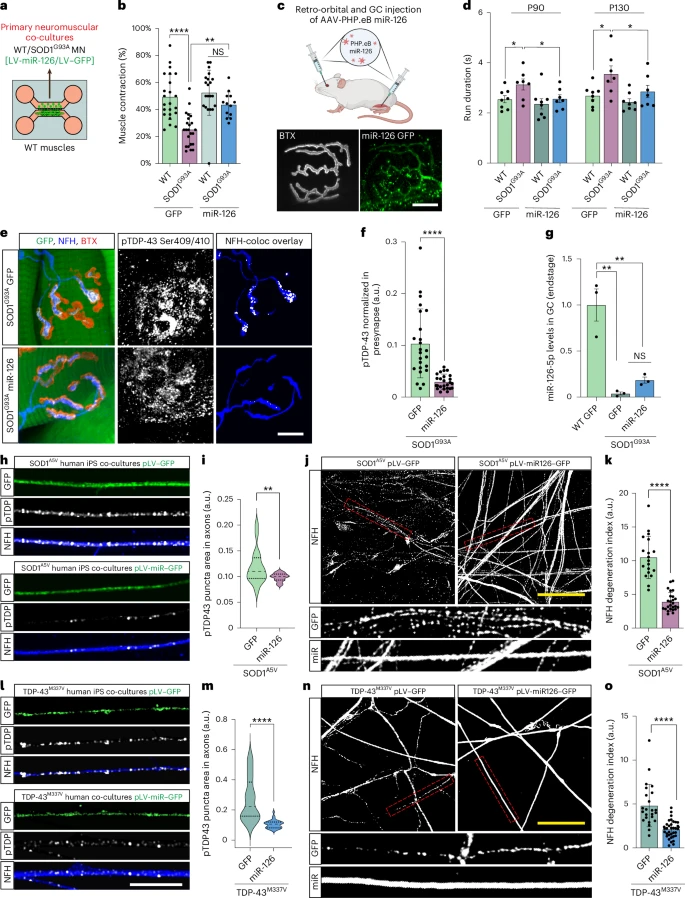 When pathologists examine the spinal motor neurons of patients with SOD1-related ALS, the nuclei generally appear normal: the TDP-43 protein is always present, and abnormal aggregates are rarely observed. This is why SOD1-related ALS has been considered "TDP-43 negative."
 Analyses statistiques contestables
